Alberta Class 7 · Sign recognition
Alberta Road Signs Test
Last updated:
Practise every sign you are expected to know for the Alberta Class 7 knowledge test — 33 signs, each with the answer and a short explanation of what the shape and colour are telling you.
Read the shape and colour before you read the words
Most learners study road signs the same way they study vocabulary: look at the picture, memorise the caption, move on. That works in a quiet room and falls apart at 60 km/h in wet snow, when a sign is half-obscured by a truck and you have about a second and a half to react. Alberta signs are designed so you do not need that second and a half. The shape and the colour carry the message on their own; the symbol inside just tells you which specific instance of that message you are looking at.
The shapes are deliberately unambiguous, and a few of them are reserved for exactly one meaning:
- Octagon — stop. Nothing else in Alberta uses eight sides, which is why a stop sign is still recognisable from behind or under snow.
- Downward-pointing triangle — yield. Also reserved, also readable as a silhouette.
- Diamond — a warning about something ahead. Yellow for a permanent road condition, orange for temporary construction.
- Pentagon — school area or school crossing.
- Rectangle and square — regulatory instructions and information, depending on colour.
Colour narrows it further. Red means prohibition or a mandatory action — stop, yield, do not enter, no left turn. Yellow means caution about a condition you will meet shortly: a curve, a hidden intersection, uneven pavement, a railway crossing. Orange means people are working on the road right now, and it changes the rules that were true yesterday. Green means permitted movement or directional guidance, including the green circle used for dangerous goods routes. Blue points to services and facilities — hospitals, rest areas, telephones. Black on white is regulatory law you must obey, most often speed limits and lane use.
That gives you three practical categories. Regulatory signs state something legally binding; disobeying one is an offence. Warning signs describe a hazard and expect you to adjust speed and position — they are advisory in tone but the consequences of ignoring them are physical rather than legal. Information signs simply orient you. Sorting an unfamiliar sign into one of these three before you try to decode the symbol is the single fastest way to answer a sign question correctly on the test, and it is genuinely how experienced drivers process signs on the road.
Two families deserve extra attention because they carry the steepest penalties in Alberta: construction zones and school zones. Orange construction signage often includes a flag person symbol and reduced speed limits that are enforceable whether or not workers are visible, and fines in these zones are doubled. School and playground zone signs are pentagons with clearly posted hours, and Alberta learners routinely lose marks on questions about when those reduced limits actually apply. Study those two groups separately from the rest.
The quiz below is the same sign set used in the app. Questions are generated dynamically from the 33 signs, so the order and framing change between runs. Note that sign mode does not save or resume — each start is a fresh pass, which is fine, because the goal is repetition until recognition becomes automatic rather than steady progress through a list.
6 sample road sign questions
These are real questions from the sign set, shown with their answers so you can check your reasoning before you start.
Question 1
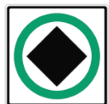
This sign indicates:
- Route for vehicles over 4500 kg
- Route for slow moving vehicles
- Reserved lane for buses
- Dangerous goods route
Question 2
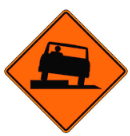
This sign indicates:
- Off-road facilities ahead
- Slippery when wet
- Uneven pavement
- Detour ahead
Question 3
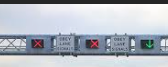
A traffic-lane control light with an illuminated red 'X' means:
- Prepare for an emergency vehicle
- Reduce speed to below 30 km/h
- Use that lane only for left turns
- Travel is not permitted in that lane
Question 4
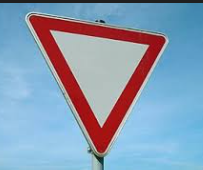
When approaching a Yield sign, you must:
- Give right-of-way to traffic and pedestrians already present
- Sound the horn before entering the intersection
- Expect oncoming vehicles to yield the right-of-way to you
- Come to a full stop, then proceed after a left-right check
Question 5
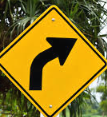
This sign indicates:
- Traffic entering from the right
- Winding road ahead
- Curve right
- Concealed intersection on the right
Question 6
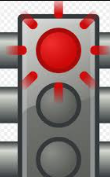
A driver approaching a flashing red traffic light must:
- Stop and wait for the flashing green light
- Reduce speed and proceed with caution
- Stop and proceed only when safe to do so
- Stop until the signal turns green
Common questions about Alberta road signs
How many road signs are on the Alberta knowledge test?
There is no fixed sign count published for the real exam — signs are mixed in with rules-of-the-road questions throughout the test. Our sign mode covers 33 sign keys, which is the practical set an Alberta Class 7 learner is expected to recognise on sight.
Are road signs actually on the Alberta written test?
Yes. Sign recognition is part of the Class 7 knowledge test. Some questions show a sign and ask what it means; others describe a situation and expect you to know which sign governs it.
What do the road sign shapes and colours mean in Alberta?
Shape and colour carry the meaning before you read a word. An octagon is always stop, a downward triangle is always yield, a yellow diamond is a warning, an orange diamond is construction, and a pentagon is a school area. Red and white means a legal requirement, green means permitted or directional, and blue means a service or facility.
What is the difference between regulatory, warning and information signs?
Regulatory signs state a law you must obey, such as a stop sign or a speed limit. Warning signs alert you to a hazard ahead, such as a curve or uneven pavement, and are usually yellow or orange diamonds. Information signs point you to services, routes and destinations, and are usually green or blue.
How do I memorise Alberta road signs quickly?
Learn the categories rather than the individual pictures. Once you can sort a sign by its shape and colour, you have already narrowed the answer to a handful of options, and the symbol confirms which one. Running the sign quiz a few times and reading the explanation on every miss is faster than flashcards — and the printable Alberta road signs cheat sheet is useful for the last review before you go in.
Does the sign quiz save my progress?
No. Sign mode does not save or resume — questions are generated dynamically from the sign set each time you start, so every run is a fresh pass through the signs.
Keep studying
Practising elsewhere? Try our Ontario G1 practice test, BC Class 7L practice test, or Saskatchewan road signs test.